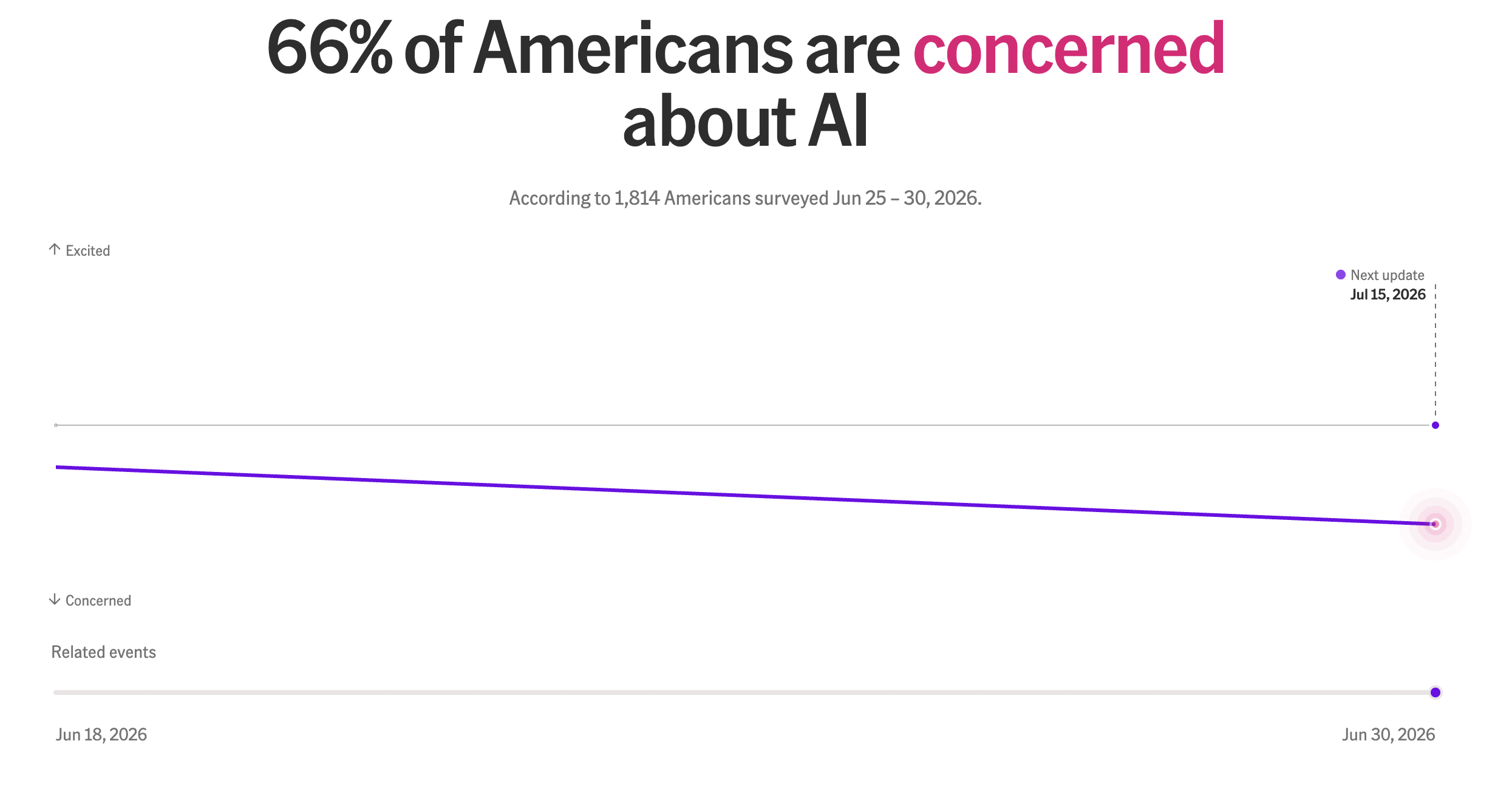
Athena Insights launched its first research project this week: Americans on AI. It's a tracking survey of how American adults feel about artificial intelligence. Waves are fielded every two weeks by NORC at the University of Chicago on AmeriSpeak. Between 1,000 and 2,000 adults complete each wave.
Athena Insights launched its first research project this week: Americans on AI. It's a tracking survey of how American adults feel about artificial intelligence. Waves are fielded every two weeks by NORC at the University of Chicago on AmeriSpeak. Between 1,000 and 2,000 adults complete each wave.

The Department of Housing and Urban Development is denying Freedom of Information Act requests for information on the development and use of artificial intelligence to inform policy decisions. Christopher Sweet and Scott Langmack were working at the Department of Government Efficiency (DOGE). They used AI to identify agency rules for potential rescission, or contract cancellations, as part of an effort across the government.
There are three categories of AI-driven suffering risks: human misuse of AI, uncontrolled misaligned AI, and uncontrolled AI aligned with flawed values. Policymakers and developers should focus more on AI governance and development, assess AI systems’ impacts on suffering, and ensure responsible human control over AI systems.

By accepting optional cookies, you consent to the processing of your personal data. Some third parties are outside of the European Economic Area, with varying standards of data protection. See the privacy policy for more information on the use of personal data on the site.

Deepfakes undermine the credibility that makes digital care possible. Investigations have documented AI-generated videos impersonating specific clinicians to promote supplements and other dubious treatments on major platforms. It raises the question: Who can patients trust? . . i

Rep. Greg Casar is the chair of the House's Congressional Progressive Caucus. He wants to see more members of his party stand up for working people. The AI industry is spending a lot of money in this year's elections to influence Congress to stand back on regulating the industry. Leading the Future and Public First Action have raised more than $200 million so far and 25 of them have won their primaries.
Athena Insights launched its first research project this week: Americans on AI. It's a tracking survey of how American adults feel about artificial intelligence. Waves are fielded every two weeks by NORC at the University of Chicago on AmeriSpeak. Between 1,000 and 2,000 adults complete each wave.
Athena Insights launched its first research project this week: Americans on AI. It's a tracking survey of how American adults feel about artificial intelligence. Waves are fielded every two weeks by NORC at the University of Chicago on AmeriSpeak. Between 1,000 and 2,000 adults complete each wave.
The Department of Housing and Urban Development is denying Freedom of Information Act requests for information on the development and use of artificial intelligence to inform policy decisions. Christopher Sweet and Scott Langmack were working at the Department of Government Efficiency (DOGE). They used AI to identify agency rules for potential rescission, or contract cancellations, as part of an effort across the government.
There are three categories of AI-driven suffering risks: human misuse of AI, uncontrolled misaligned AI, and uncontrolled AI aligned with flawed values. Policymakers and developers should focus more on AI governance and development, assess AI systems’ impacts on suffering, and ensure responsible human control over AI systems.
By accepting optional cookies, you consent to the processing of your personal data. Some third parties are outside of the European Economic Area, with varying standards of data protection. See the privacy policy for more information on the use of personal data on the site.
Deepfakes undermine the credibility that makes digital care possible. Investigations have documented AI-generated videos impersonating specific clinicians to promote supplements and other dubious treatments on major platforms. It raises the question: Who can patients trust? . . i
Rep. Greg Casar is the chair of the House's Congressional Progressive Caucus. He wants to see more members of his party stand up for working people. The AI industry is spending a lot of money in this year's elections to influence Congress to stand back on regulating the industry. Leading the Future and Public First Action have raised more than $200 million so far and 25 of them have won their primaries.